
We’re only 13 years into the 21st century, and it may take us awhile to shake off the mistakes of the 20th.
In 1953, the CIA overthrew the legitimately elected government of Iran because Mohammed Mossadegh was less than totally subservient to American oil interests. I guess he was sort of a Middle Eastern, mid 20th century version of Hugo Chavez. From then until 1979, Iran was ruled by Shah Reza Pahlavi, who was popular with the oil companies, US governments and the CIA, but not so much with the Iranian people. In 1979, they had an Islamic revolution and relations have been somewhat strained between our two countries ever since.
I have an Iranian-American friend. He says either way you look at it, it’s his patriotic duty to kill himself.
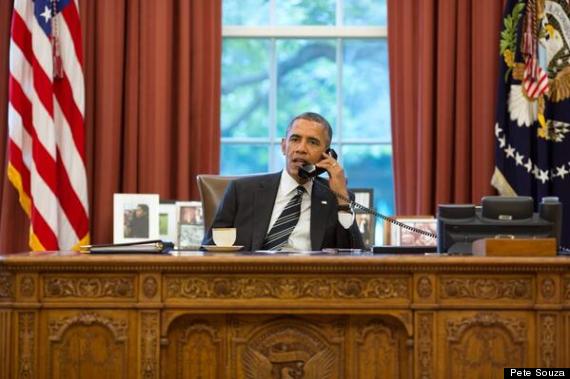
1953 called. They want their phone back.
Anyway, to get to the point, Barack Obama recently talked on the phone with Iranian President Hassan Rouhani, who replaced Mahmoud Ahmedinajad in June. It was the first time since 1979 that there’s been a direct contact between the leaders of the two countries.
It doesn’t mean that all of our conflicts are resolved, but it’s a first step. Looking at this photo, though, which was released by the White House, I was struck by one thing. Outside of the hue of the President’s skin (which, admittedly, is a pretty big difference), this photo could have been from 1979, or indeed from 1953. It’s the land line.
Of course, when you’ve got a cool desk like that in the most traditionally powerful office in the world, you’re going to stick to the land line. And, it’s not as if Barack Obama is a low tech president. Although it was Rouhani who took to Twitter afterwards, Obama is reasonably fluent with that tool.
I was just struck by the symbolism, that’s all.
And, it makes me wonder, how much easier it would be to achieve world peace, if the discussions actually took place on facebook and twitter, between the citizens of Iran and the citizens of the United States, and not just with an occasional phone call between the leaders. Because the people, for the most part, on both sides, would like nothing more than to get along, to have trade and cultural exchanges and friendships between the two countries, instead of arguments and war. The governments, not so much.
 www.gurukalehuru.com