
This is an interesting read on the topic of the computer that has “passed” the Turing Test. I put passed in quote marks because the computer program didn’t fool everybody that inter-reacted with it and also, by claiming to be a 13 year old Ukrainian boy, I think they were cheating a little bit. It means people would overlook strange syntax, and tend to ascribe their doubts about the computer program’s humanity to their own lack of knowledge of 13 year old Ukrainian boys.
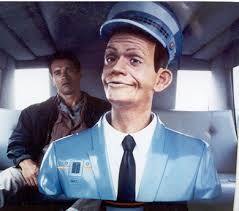
This driver is about to have his head ripped off
Still, if it fooled even 50% of the people, it’s the most advanced chatbot out there, and future models will totally ace the Turing Test. Scary stuff. Exciting stuff.
Anyway, I agree with 50% of this writer’s premise. His thesis statement is: In essence, being human is fundamentally a moral category, not a biometric one – it is unlikely that artificial intelligence will ever surpass us on this score. I agree with the first half of that sentence. We may build computers that can multiply 72 digit numbers in their head instantaneously, that can recite all of Shakespeare’s plays verbatim, off the top of their (analogous) head, who can answer any question concisely and precisely, with backing examples and references to related materials, but they won’t give a damn if any given human being lives or dies, and will have no idea why they should.
Unless, of course, we start to program that compassion in. Just like artificial intelligence, it will be artificial compassion, but I think the author is wrong in thinking it will never happen. Compassion is a human (and animal) behavior, which has evolved over billions of years, but it’s still just a question of chemicals and neural synapses. We’re going to get there eventually, and the day when a computer can pass a Turing Test for compassion may not be as far in the future as the author thinks.
Remember Arnold Schwarzenegger tearing the head off the Johnny Cab robo-driver in Total Recall? It was funny because pretty much anybody who has ever taken a cab in New York City has wanted to rip the driver’s head off at some point in the journey. Either they talked too much or were too rude and abrupt, tried to cheat, or displayed some amazing bit of insensitivity. It will not be difficult to program robo-drivers for cabs and busses who are more compassionate than their human counterparts.
Shop clerks, waiters and waitresses, receptionists, ditto. There will be friendly robo-police officers walking the streets, who can give people correct directions without giving them attitude. There will be teachers who never lose their temper, who answer the most incredibly boneheaded questions with sweet equanimity, and who can tell just by looking at a students face muscles whether they really need to go to the toilet or if they’re just trying to get out of the class.
It won’t be hard. Compassion may be the difference between humans and machines but, honestly, we’re not all that great at it.
 www.gurukalehuru.com