
Czech archeologists announced yesterday that they’ve discovered the tomb of an Egyptian Queen nobody’s ever heard of before. That’s nice. It’s not earth shattering, like a radio signal from another star or teleportation or anything, but it’s one more, another piece of the puzzle.
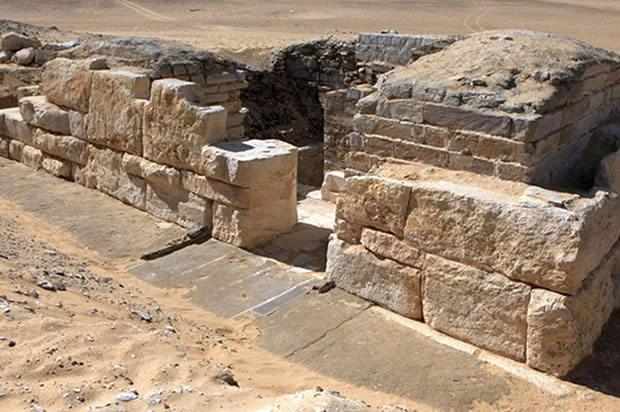
Tomb of Khentakawiss III, cca 4,500 b.c.
We know far more about the history of ancient Egypt than people 100 years ago did, and they were a hundred years closer to it. So, progress.
The discovery is about halfway between the Pyramids at Giza (the famous ones) and the ones at Saqqarah (not as big, not as famous, but a lot more extensive), and it’s in the middle of a whole bunch of other pyramids, so that there is now a huge area of suburban Cairo, a quarter of a ring around the giant city, the southwestern quadrant, which is almost solid pyramids. That’s a slight exaggeration, there’s a lot of sand in between, but nonetheless, it is the urban sprawl of the dead.
I wonder about planets where the intelligent life forms are fifty, a hundred thousand, or a million years more evolved than us. We have left so much historical rubble strewn across our planet and our entire civilization is only 10,000 (if you count from the beginning of written language) or 65,000 (if you count from the beginning of agriculture) years old.
Think of how the pace of progress has picked up over the last hundred of those 10,000 years. Then think of how that will double and redouble and then mutate until we break through all limitations into the realm of all seeing and all knowing.
Meanwhile, we’d better learn to manage our resources and our land usage a little better or sometime in the future, maybe a few thousand years from now, you won’t be able to walk for all the archaeological finds.
The pyramid
 www.gurukalehuru.com