
There’s an excellent article up over on Huffpo by an academic at Stanford named Clarence B. Jones. Well, actually, it was a mildly interesting article. He praised Martin Luther King a lot. That’s nice, but not terribly original. Then he talked about a whole lot of different issues and it got a bit long winded.
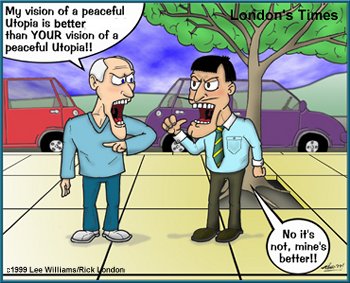
We can work it out
But I loved the teaser sentence: It has now become clearer to me than ever before that the challenge confronting the world is to find innovative forms of verbal and written communication to enable us to resolve disputes nonviolently.
I think the internet holds the key. Comment threads, blogs, facebook, twitter, etc… all provide forums for debate. But it goes nowhere. It provides us with a place to vent, but it doesn’t actually affect policy. You can have, literally, millions of people marching in the street and if the government wants to ignore them, it ignores them. You can elect candidates who promise change, and hope, but when they don’t deliver change there’s no hope we can do anything about it.
The solutions exist. It is possible to get fresh water, for drinking and growing food, to every corner of the world. It’s possible to build enough homes for everybody. It’s possible to produce enough energy to make everything run, without destroying the environment. It’s possible to contain the population explosion.
We just need to develop the framework for presenting solutions, refining them until they are workable, and implementing them. Politicians aren’t going to do it.
 www.gurukalehuru.com
It’s a nice vision, but the stumbling block is, and ever will be, the “blockheads”. They’re too numerous. If you graphed the relative intelligence of humanity, it could well look like a pyramid shape, with the more intelligent, but far fewer, near the top. For every Einstein or Feynman, you have 10 Bubbas. Probably more. And it’s axiomatic that you can’t have a rational discussion with irrational people.
Well, that’s true and it is the crux of the problem. But even though they may know nearly nothing of history, theories of government and economics, science and so on, I have often noticed that they’re better than me when it comes to fixing a car or putting an addition onto their home.
The goal is, first, to figure out a society, an infrastructure, that will work to everybody’s benefit, and then to sell it.